
Table of Contents
- Why Packaging Sustainability Needs a Reset
- Traditional Plastic: Why Plastic Is Bad (Even When It Performs Well)
- Recyclable Packaging: A Label That No Longer Means What It Did
- PCR (Post-Consumer Recycled Content): The Best Near-Term Option
- Compostable Packaging: The Only Option with Infinite Upside
- Barrier Performance: Dispelling the “Compostables Don’t Work” Myth
- Regulatory Momentum: Why Policy Is Choosing Compost
- Frequently Asked Questions
- Conclusion: Where We’re Betting—and Why
I. Why Packaging Sustainability Needs a Reset
Packaging conversations have been stuck in the same loop for decades. Plastic versus recyclable. Virgin versus recycled. Performance versus sustainability. What’s missing is honesty about end-of-life reality.
Sustainability is not about what a package could be in theory. It’s about what actually happens after a consumer throws it away.
Extended Producer Responsibility (EPR) laws, recycled content mandates, and composting regulations are forcing the industry to confront that reality head-on. And when you zoom out, a clear hierarchy emerges.
II. Traditional Plastic: Why Plastic Is Bad (Even When It Performs Well)
Plastic is everywhere because it works. It’s cheap, light, strong, flexible, and provides excellent oxygen and moisture barriers. From a purely technical standpoint, plastic is hard to beat.
That’s exactly the problem.
Plastic’s Strengths Are Exactly the Problem
Plastic was designed to last. Nature was not.
A plastic pouch may protect food for months, but once discarded it persists for decades—or centuries. Even when it breaks down, it becomes microplastics that remain biologically active in soil, water, and organisms.
End-of-Life Reality
Despite decades of recycling campaigns, the vast majority of plastic packaging still ends up:
- In landfills
- Incinerated
- Leaking into waterways and ecosystems
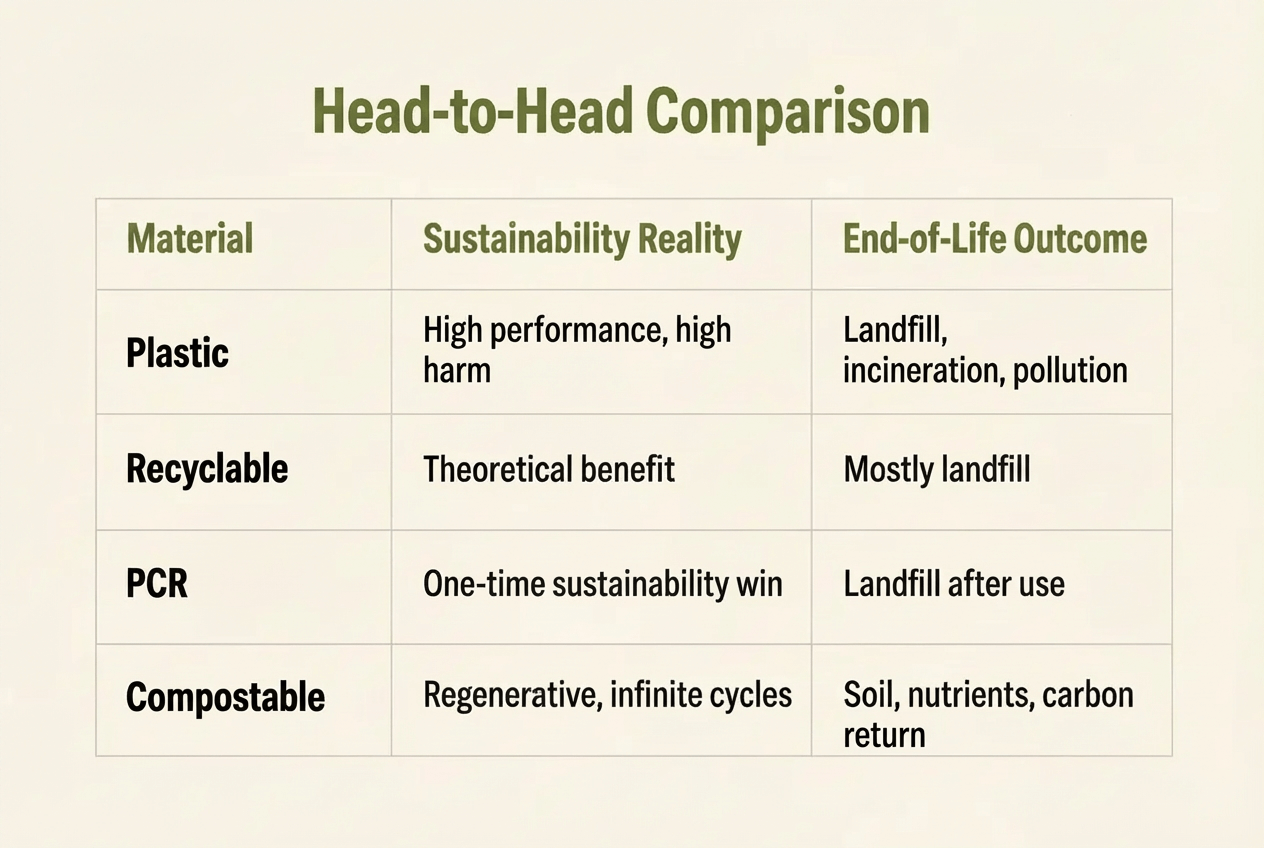
Once plastic reaches this stage, its environmental cost compounds over time. There is no regenerative pathway. No return to nature. Just accumulation.
This is why plastic is bad—not because it performs poorly, but because it performs too well in a system that cannot recover it.
III. Recyclable Packaging: A Label That No Longer Means What It Did
“Recyclable” sounds responsible. For years, brands leaned on the label as proof of sustainability.
Today, that label is collapsing under scrutiny.
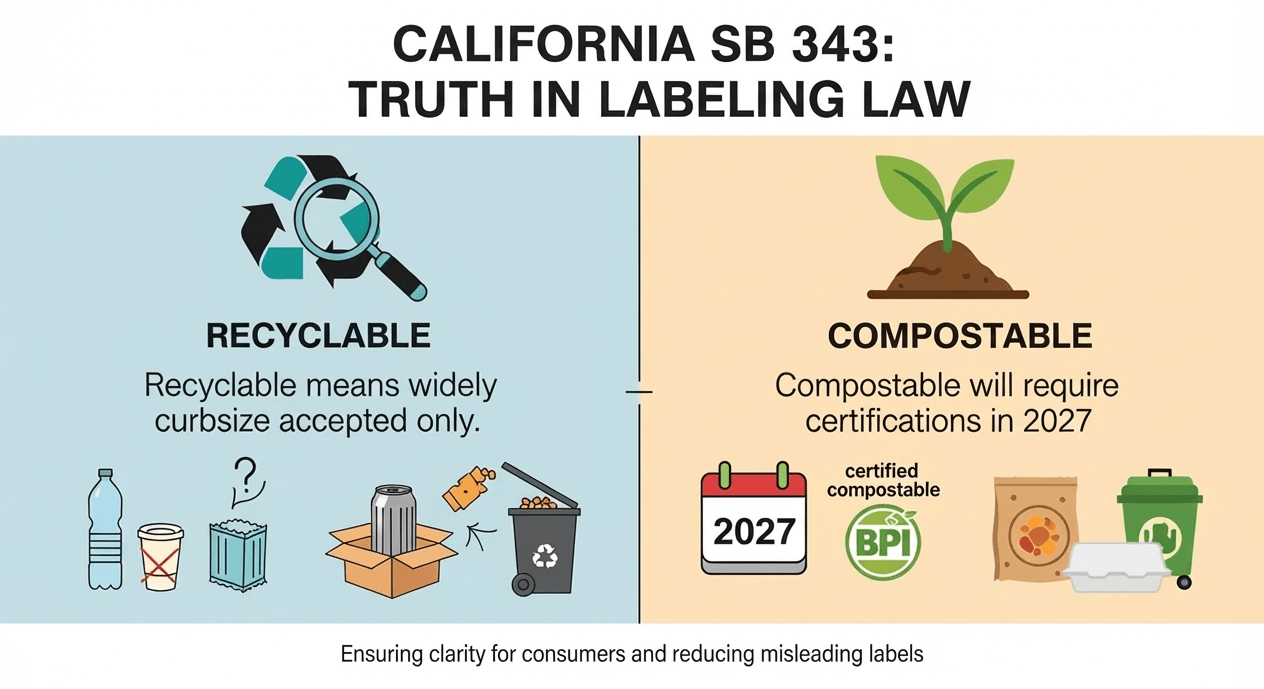
“Recyclable often means 'theoretically recyclable, practically trashed.'”
Why “Recyclable” Is No Longer Recyclable in California
California’s recycling regulations now require that materials be actually recycled at scale to be labeled recyclable. Many flexible plastic packages fail this test due to:
- Low capture rates
- Limited sorting capability
- No viable end markets
In practice, recyclable often means “theoretically recyclable, practically trashed.”
Infrastructure Mismatch and Consumer Confusion
Recyclable packaging depends on:
- Perfect consumer behavior
- Local infrastructure availability (especially since other countries stopped accepting our ‘recyclables’ in 2018*)
- Clean, uncontaminated material streams
That is an unrealistic standard. When systems fail, recyclable packaging defaults to landfill—indistinguishable from virgin plastic in outcome.
IV. PCR (Post-Consumer Recycled Content): The Best Near-Term Option
PCR is where sustainability becomes real—at least in the short term. And there does seem to be a magic number where consumers respond to the effort, which is at 70% or more PCR content, with diminishing returns above 75%*.
Using 70%+ post-consumer recycled content means:
- The plastic already existed
- Waste was diverted once
- Demand for virgin resin is reduced.
That matters.
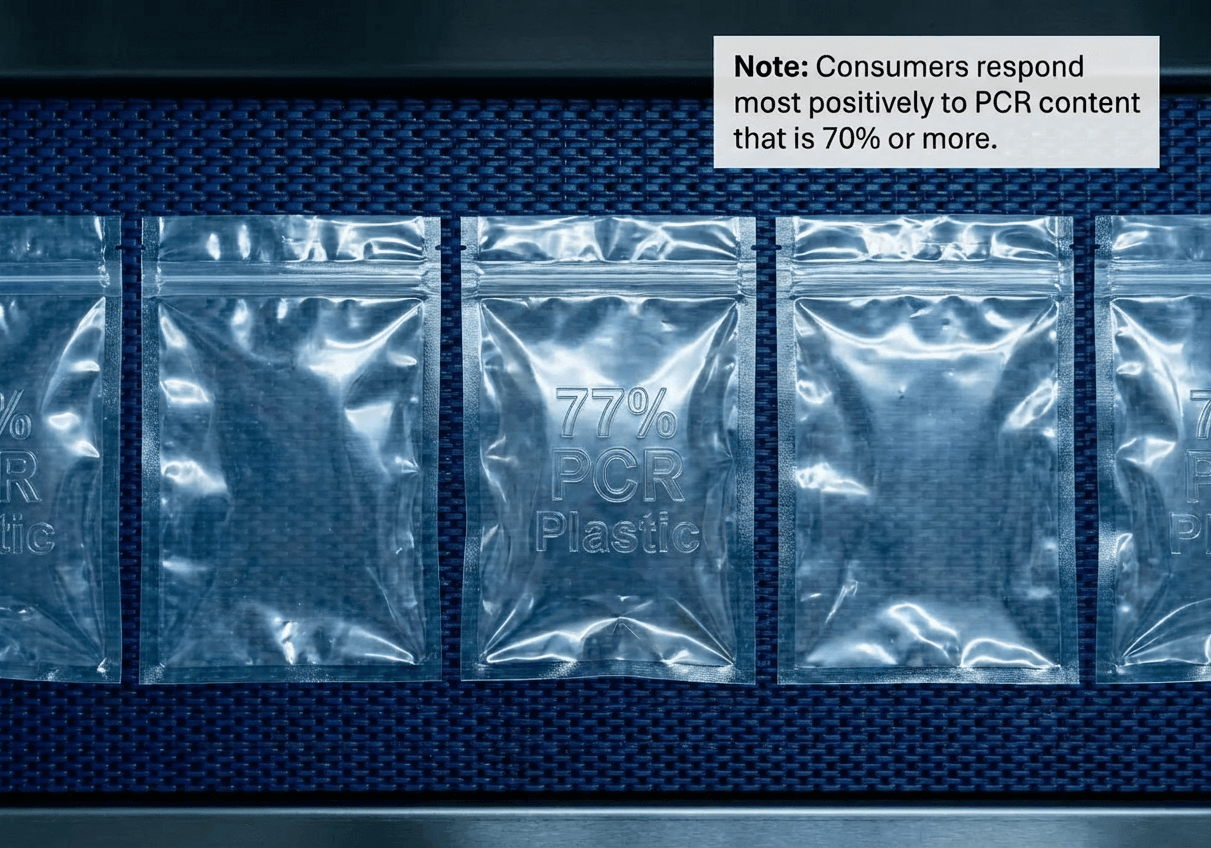
Why 70%+ PCR Means the Good Has Already Been Done
PCR packaging completes its sustainability benefit at the moment of production. The environmental “good” happens when waste is reprocessed into new material.
After that, the cycle ends.
“PCR packaging completes its sustainability benefit at the moment of production.”
The Sustainability Ceiling of PCR
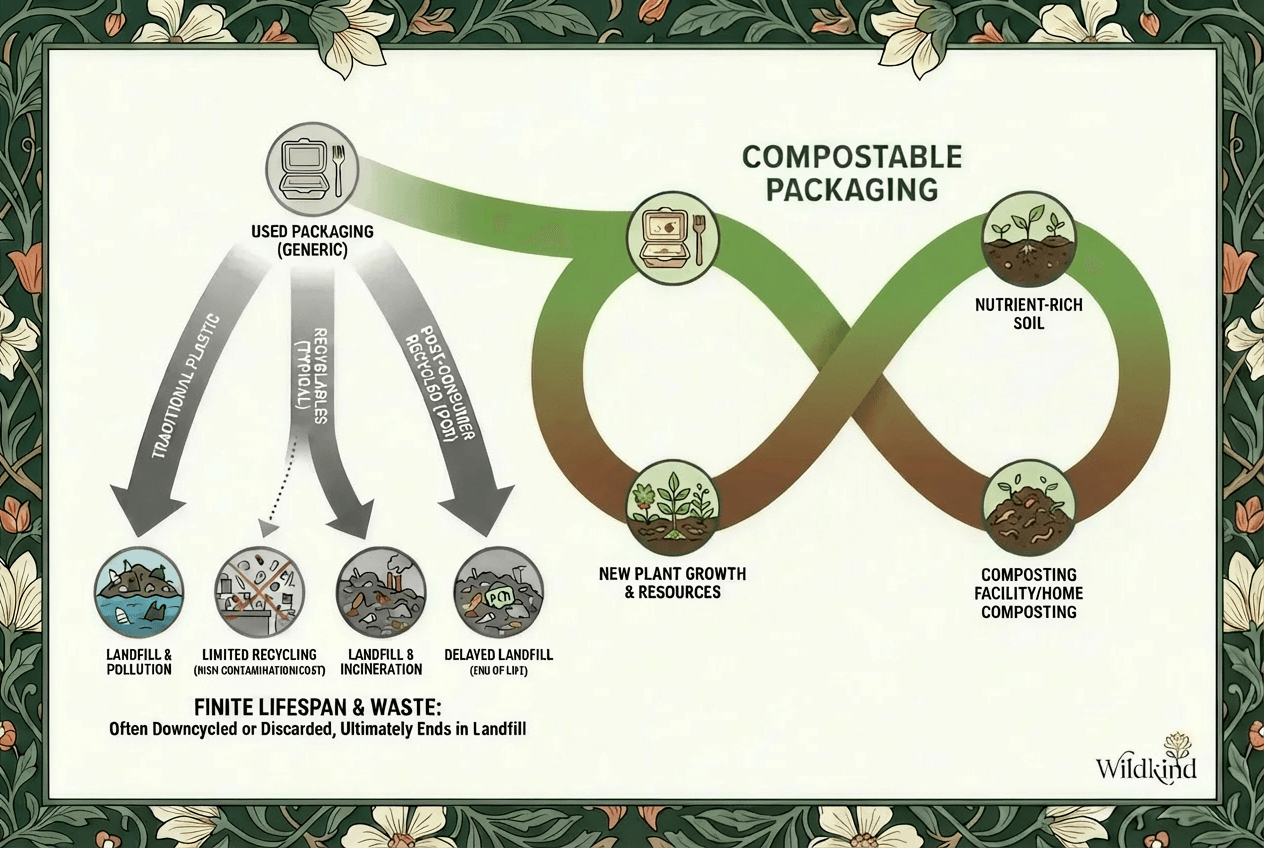
At end-of-life, PCR packaging faces the same fate as virgin plastic:
- Difficult to recycle again
- Often contaminated
- Typically landfilled
PCR is not circular. It is a single recovered loop, not an infinite system. That doesn’t make it bad—it makes it limited.
V. Compostable Packaging: The Only Option with Infinite Upside
Compostable packaging operates on a fundamentally different logic.
It is designed to end, not persist.
Compostables and the Natural Carbon Cycle
Certified compostable packaging:
- Breaks down into carbon dioxide, water, and biomass
- Leaves no toxic residue
- Becomes feedstock for soil health.
Each compost cycle creates value:
- Healthier soils
- Reduced methane from landfilled food waste
- Closed-loop organic systems
Unlike plastic or PCR, compostables don’t cap out. They regenerate.
Compostables in EPR Laws and Infrastructure Expansion
Modern EPR programs increasingly recognize compostables as a legitimate recovery pathway. States like California, Colorado, Minnesota, Maryland, and Washington explicitly include compostables in:
- Needs assessments
- Funding for composting infrastructure
- Education and labeling standards
When EPR funds composting systems, compostable packaging reaches its highest and best use: feedstock for compost.
VI. Barrier Performance: Dispelling the “Compostables Don’t Work” Myth
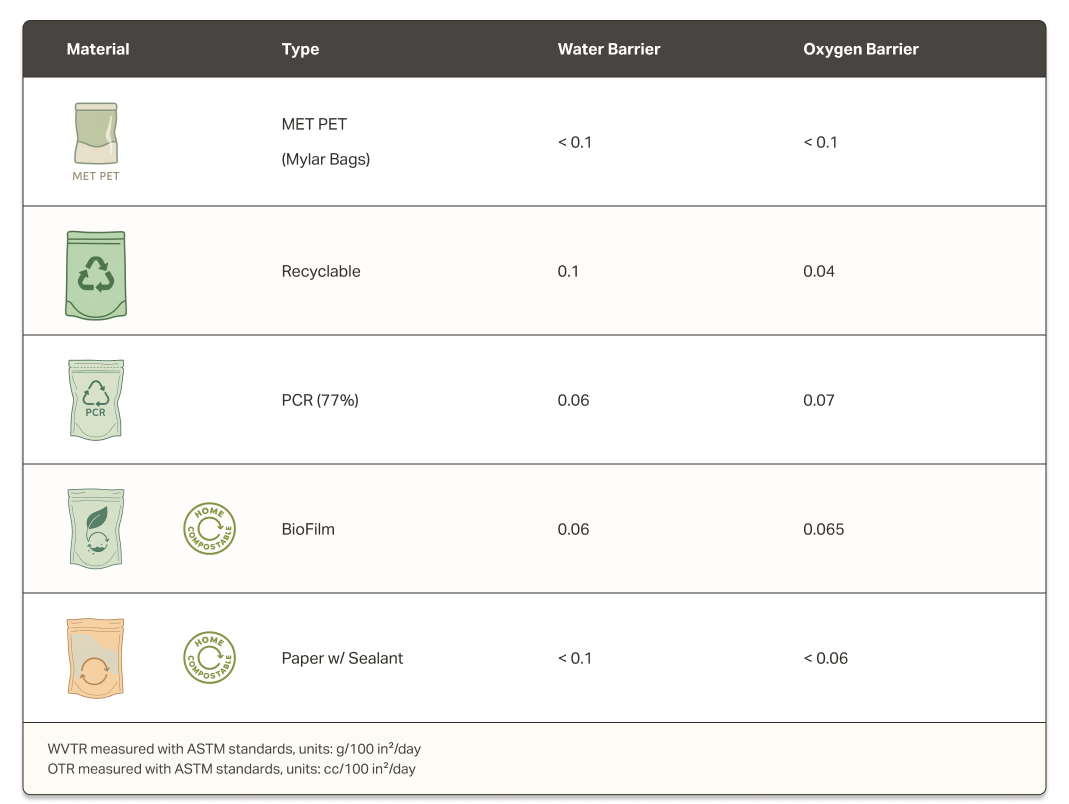
A common objection is performance. The data tells a different story.
Compostable films now achieve:
- Water vapor transmission rates comparable to recyclable and PCR materials
- Oxygen barrier performance within functional food packaging thresholds.
The performance gap has closed. Sustainability is no longer a tradeoff—it’s a choice.
VII. Regulatory Momentum: Why Policy Is Choosing Compost
PCR laws are spreading, but they stop at content requirements. Compostable packaging, by contrast, is being embedded directly into waste system design through EPR frameworks.
Policy is signaling the future:
- Reduce virgin plastic
- Capture organics
- Build composting infrastructure
- Design packaging that fits the system-not the other way around.
VIII. Frequently Asked Questions
- Is PCR better than virgin plastic?
Yes. PCR reduces demand for new plastic and diverts waste once. It’s a meaningful improvement. - Why isn’t recyclable enough?
Because most recyclable packaging is not actually recycled at scale. - Do compostables require special facilities?
For scale? Yes—industrial composting. That’s why EPR funding and policy alignment matter. However, most of our offerings are home compostable for those that have the patience for it. - Are compostables worse if landfilled?
Compostables aren’t worse than plastic if landfilled—but landfill prevents them from delivering their intended benefit, which is why composting access and infrastructure matter. - Is barrier performance still an issue?
No. Modern compostable films meet most functional packaging needs. - What’s the best long-term solution?
Packaging designed to return to nature within supported infrastructure.
“[Compostable Packaging] is inevitable if we’re going to thrive as a species.”
IX. Conclusion: Where We’re Betting—and Why
Plastic is bad because it never ends.
Recyclable is broken because the system can’t deliver.
PCR is great—but finite.
Compostable packaging is the only option aligned with regulation, infrastructure investment, natural systems and long-term sustainability.
That’s where we’re betting-not because it’s trendy, but because it’s inevitable if we’re going to thrive as a species.

Login and Registration Form